
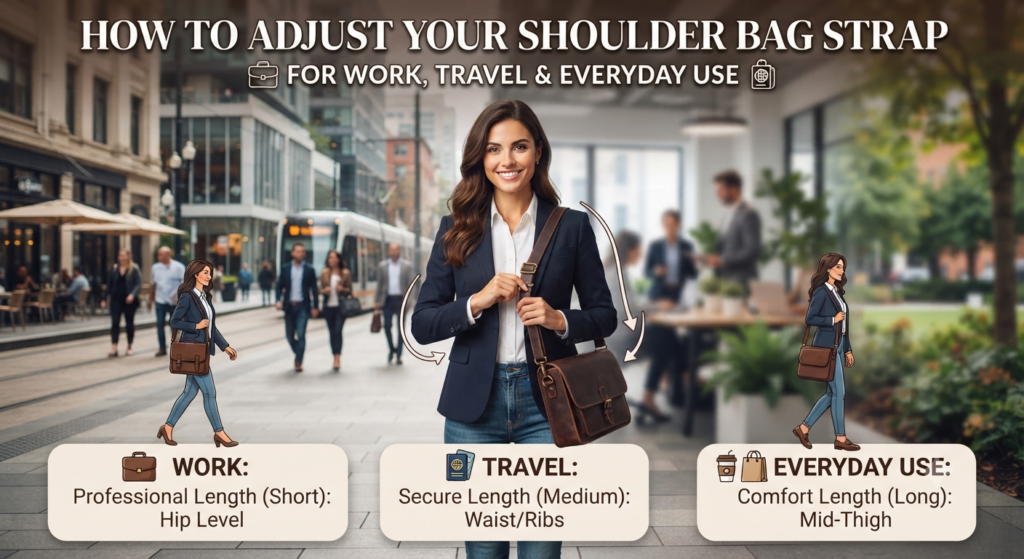
A shoulder bag can be stylish, practical, and comfortable, but the wrong strap length can quickly make it difficult to carry. A strap that is too short may feel restrictive, while one that is too long can cause the bag to swing, sit too low, or become difficult to access. Learning how to adjust your shoulder bag strap according to the situation can improve both comfort and functionality.
The ideal strap length depends on where you are going, what you are carrying, how you are wearing the bag, and how long you plan to carry it. Your preferred adjustment for an office commute may not be the same as the one you need for a shopping trip or a long day of travel.
In this guide, we’ll explain how to adjust your shoulder bag strap for work, travel, commuting, shopping, and everyday use, along with practical tips for finding a comfortable fit.
Why Is Shoulder Bag Strap Adjustment Important?
The strap controls where your bag sits against your body. A proper adjustment keeps the bag secure while allowing easy access to your belongings.
An incorrectly adjusted strap can make your bag uncomfortable and affect how you move. If the bag hangs too low, it may swing while walking. If it sits too high, it can feel restrictive around your shoulder and arm.
Proper strap adjustment can help you:
- Carry your essentials more comfortably
- Keep your bag in a stable position
- Access your belongings more easily
- Reduce unnecessary movement while walking
- Create a more polished appearance
- Adapt the same bag to different occasions
How to Find the Right Shoulder Bag Strap Length
Before adjusting your bag for a specific situation, start by finding a comfortable basic position.
Place the bag on your shoulder and let it hang naturally. The bottom of the bag should sit in a position that allows you to move your arm freely without the bag constantly swinging.
Consider these factors:
Your height: Taller people may prefer a slightly longer strap, while shorter users may find a shorter adjustment more comfortable.
Bag size: Larger bags can often sit slightly lower, while smaller bags may work better when positioned closer to the body.
What you are carrying: A heavier bag may feel more stable when it sits closer to your body.
Your clothing: Thick jackets or layered clothing may require a little extra strap length.
Activity: Walking, commuting, working, and travelling may each require a different adjustment.
How to Adjust Your Shoulder Bag Strap for Work
For office and professional settings, your shoulder bag should be comfortable without looking too loose or oversized.
A medium strap length usually works well for everyday office wear. Position the bag so that it sits comfortably at your side and doesn’t interfere with your arm movement.
Tips for Office Use
- Keep the bag relatively close to your body.
- Avoid letting the bag hang excessively low.
- Adjust the strap so you can easily reach your essentials.
- Make sure the bag doesn’t constantly slide off your shoulder.
- Consider your blazer, coat, or other workwear when adjusting the strap.
For example, if you’re wearing a blazer, you may need to slightly lengthen the strap so the bag sits naturally over your clothing.
Why This Adjustment Works
A balanced strap length gives you a neat appearance while keeping your work essentials accessible. It is particularly useful when carrying items such as a wallet, phone, notebook, cosmetics, or other daily necessities.
How to Adjust Your Shoulder Bag Strap for Commuting
Commuting often involves walking, public transportation, stairs, and crowded spaces. Your shoulder bag should therefore stay relatively close to your body.
For commuting, consider slightly shortening the strap compared with your relaxed everyday setting.
This can help prevent the bag from swinging excessively as you walk.
Commuting Adjustment Tips
- Keep the bag close to your side.
- Avoid an excessively long strap.
- Make sure the bag doesn’t swing behind you.
- Keep frequently used items in an easy-to-reach compartment.
- Check that the strap remains comfortable over your clothing.
If you frequently use buses, trains, or other crowded transportation, a closer-fitting position can also make the bag easier to manage.
How to Adjust Your Shoulder Bag Strap for Travel
Travel often means carrying your bag for several hours. Comfort should therefore be your priority.
For longer journeys, adjust the strap so the bag feels stable and close enough to your body without restricting movement.


For Airport Travel
When travelling through an airport, you may want slightly more room to move your arms, particularly when carrying luggage.
Check that:
- The bag doesn’t interfere with your suitcase handle.
- The strap stays securely on your shoulder.
- Your passport, phone, and travel documents are easy to access.
- The bag isn’t hanging so low that it constantly moves while walking.
For Sightseeing
If you’ll be walking for several hours, avoid letting the bag hang too far away from your body. A stable position can make walking more comfortable.
You may also want to adjust the strap depending on the amount of clothing you’re wearing and the weight of the bag.
How to Adjust Your Shoulder Bag Strap for Everyday Use
Everyday activities usually require a flexible strap adjustment.
Whether you’re going to a café, meeting friends, running errands, or heading out for a casual day, you can choose a relaxed strap length that allows natural movement.
A medium or slightly longer setting can work well for casual use, depending on your height and bag design.
Everyday Adjustment Tips
- Choose a length that feels natural when walking.
- Keep your phone and frequently used items accessible.
- Make sure the bag doesn’t constantly slip from your shoulder.
- Avoid overloading the bag.
- Adjust the strap when changing from light to heavy contents.
The best everyday setting is one that feels comfortable enough that you don’t have to keep repositioning the bag.
How to Adjust Your Shoulder Bag Strap for Shopping
Shopping involves frequent movement and reaching, so accessibility is important.
You may prefer to keep the bag slightly closer to your body so that it doesn’t get in the way while browsing or carrying shopping bags.
If you’re carrying several items, check that the shoulder bag remains balanced and doesn’t pull excessively on one side.
Quick Shopping Tips
- Keep the bag secure against your side.
- Avoid an extremely long strap.
- Keep valuables in zipped compartments.
- Don’t overload the shoulder bag.
- Re-adjust the strap if your shopping load changes.
How to Adjust the Strap When Carrying a Heavy Bag
The weight of your bag can change how the strap feels.
When carrying heavier items, keeping the bag closer to your body can make it feel more stable than allowing it to hang far away from you.
However, strap adjustment alone cannot compensate for an excessively heavy bag.
For a Heavy Shoulder Bag:
- Remove unnecessary items.
- Distribute the contents evenly.
- Adjust the strap to a comfortable length.
- Keep the bag reasonably close to your body.
- Change shoulders when appropriate if the bag design allows it.
A lighter bag is generally easier to carry than simply tightening the strap.
How Should You Adjust a Shoulder Bag for Different Body Types?
There isn’t one universal strap length that works for everyone. Your height, body proportions, clothing, and preferred carrying position all influence the ideal adjustment.
Petite Body Types
A slightly shorter strap may help prevent a large shoulder bag from hanging too low.
Taller Body Types
A longer strap may provide a more natural position, particularly with larger bags.
Different Clothing Layers
If you’re wearing a thick sweater, jacket, or coat, you may need to slightly lengthen the strap.
The key is not to follow a fixed measurement but to find a position where the bag feels stable and allows comfortable movement.
Common Shoulder Bag Strap Adjustment Mistakes
Even an adjustable bag can become uncomfortable if the strap isn’t positioned correctly.
1. Making the Strap Too Long
An excessively long strap can cause the bag to swing and make it harder to access your belongings.
2. Making the Strap Too Short
A very short strap can restrict your arm movement and make the bag feel uncomfortable.
3. Ignoring the Bag’s Weight
A strap may feel comfortable when the bag is empty but uncomfortable when fully loaded.
4. Using the Same Setting for Every Situation
Your ideal length for a relaxed weekend may not be suitable for commuting or travelling.
5. Overloading the Bag
Even the perfect strap adjustment cannot make an excessively heavy bag comfortable.
Quick Shoulder Bag Strap Adjustment Guide
| Situation | Suggested Adjustment | Main Goal |
|---|---|---|
| Office | Medium | Professional appearance & easy access |
| Commuting | Slightly shorter | Stability & security |
| Travel | Medium/close to body | Long-term comfort |
| Sightseeing | Close to body | Reduce movement |
| Shopping | Medium/shorter | Easy movement |
| Everyday Use | Medium | Balanced comfort |
| Heavy Load | Closer to body | Better stability |
| Casual Outing | Medium/relaxed | Freedom of movement |
These are general guidelines. The ideal setting depends on your height, bag design, strap construction, clothing, and personal comfort.
How Often Should You Adjust Your Shoulder Bag Strap?
You don’t need to adjust your strap constantly. However, it is useful to check the setting whenever your situation changes.
For example, you may use one setting when wearing a T-shirt and a slightly longer setting when wearing a winter jacket. Similarly, a bag that feels comfortable when carrying a wallet and phone may need adjustment when you add a water bottle, notebook, or other items.
Think of your strap as an adjustable part of your bag rather than something that needs to stay at one fixed length.
Tips for Getting the Most From an Adjustable Shoulder Bag
If you use the same shoulder bag for multiple occasions, an adjustable strap can make it much more versatile.
Keep these tips in mind:
- Start with a comfortable medium length.
- Shorten the strap for activities involving more movement.
- Keep the bag closer to your body when travelling.
- Allow more room when wearing thick clothing.
- Avoid carrying unnecessary weight.
- Check that the strap hardware is properly secured.
- Adjust the strap whenever the way you carry the bag changes.
Final Thoughts
Knowing how to adjust your shoulder bag strap for work, travel, and everyday use can make a noticeable difference in comfort and convenience. There is no single perfect strap length because your ideal adjustment changes with your activity, clothing, body proportions, and the weight of your bag.
For work, focus on a neat and accessible position. For commuting and sightseeing, keep the bag stable and relatively close to your body. For everyday use, choose a relaxed setting that allows natural movement.
Ultimately, the best shoulder bag strap adjustment is the one that keeps your bag comfortable, secure, accessible, and easy to carry throughout your day.