
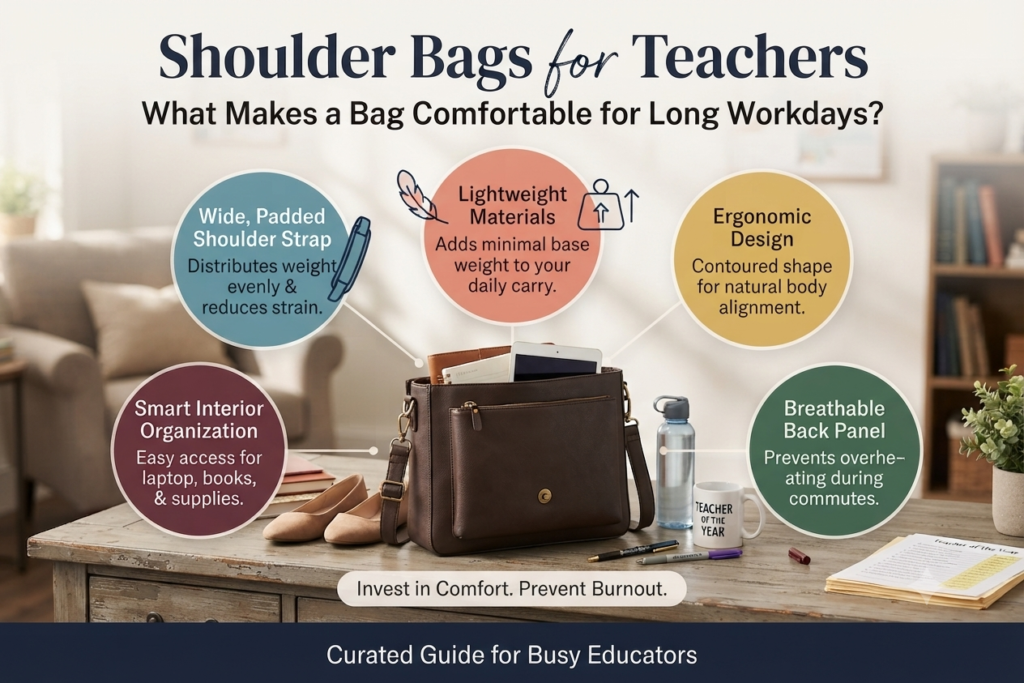


Introduction
A teacher’s workday rarely stays in one place. From entering the school in the morning to moving between classrooms, staff rooms, meetings, and after-school activities, teachers often carry their essentials for several hours.
A shoulder bag can be a practical choice because it keeps everyday items close while leaving the hands available for books, classroom materials, or other tasks. However, a stylish shoulder bag is not automatically a comfortable one.
The right teacher shoulder bag needs to balance comfort, storage capacity, organization, durability, and weight. Recent teacher-focused bag surveys also highlight roominess, portability, laptop protection, durability, and organization as important considerations.
What Does a Teacher Need to Carry?
Before choosing a shoulder bag, consider what actually goes into it.
A teacher may need to carry:
- Lesson plans
- Notebooks
- Attendance records
- Pens and pencils
- Markers
- Sticky notes
- Small teaching materials
- Laptop or tablet
- Charging cable
- Phone
- Wallet
- Keys
- Water bottle
- Lunch or snacks
- Personal care items
This means a teacher’s bag needs more than a fashionable appearance. It needs usable storage.


1. Choose a Lightweight Shoulder Bag
One of the first things to consider is the empty weight of the bag.
Teachers already have several items to carry throughout the day. If the bag itself is heavy before anything is packed inside, it can become uncomfortable once books, electronics, and personal items are added.
A recent teacher-bag guide recommends considering the bag’s empty weight alongside its capacity, while teacher surveys also indicate that many educators value lightweight bags because they frequently move between locations.
What to look for
Choose a bag that is:
- Lightweight but sturdy
- Easy to lift with one hand
- Not excessively bulky
- Designed with reinforced construction
- Comfortable when fully packed
Important: Bigger does not always mean better. A very large bag can encourage you to carry items you don’t actually need.
2. Look for a Wide and Comfortable Shoulder Strap
The strap is one of the most important comfort features.
A narrow strap can concentrate pressure on a small area of the shoulder. A wider, adjustable strap can provide a more comfortable fit and make the bag easier to position.
Physiotherapy guidance on shoulder bags recommends considering wide, adjustable and, where possible, padded straps. It also recommends switching the carrying side periodically rather than always loading the same shoulder.
Ideal strap features
| Strap Feature | Why It Matters |
|---|---|
| Wide strap | Helps spread pressure |
| Adjustable length | Allows a better fit |
| Padded surface | Improves carrying comfort |
| Strong attachment points | Supports daily use |
| Non-slip material | Helps prevent constant slipping |
Teacher tip
Don’t let the bag hang unnecessarily low. Adjust the strap so the bag stays in a comfortable position close to your body.
3. Get the Right Storage Capacity
Storage capacity is particularly important for teachers.
A bag that is too small forces you to overpack compartments or carry additional bags. A bag that is excessively large can become heavy and difficult to manage.
A teacher-focused guide suggests that a 20–30 litre range can provide a useful balance for many teachers carrying laptops, folders and other daily supplies, although the ideal capacity depends on the individual’s workload.
Suggested capacity guide
| Bag Capacity | Suitable For |
|---|---|
| Small: 5–10 L | Phone, wallet, keys, small notebook, personal essentials |
| Medium: 10–20 L | Everyday teaching essentials, notebooks, stationery, tablet |
| Large: 20–30 L | Laptop, folders, notebooks, teaching materials, water bottle |
| Extra-large: 30 L+ | Heavy teaching loads, multiple devices and larger materials |
For most teachers, medium-to-large capacity is more practical than an oversized bag.
4. Prioritize Multiple Compartments
A large empty compartment may seem convenient, but it can quickly become difficult to organize.
Imagine needing your marker during class and having to search underneath a notebook, charger, lunch box and water bottle.
Separate compartments create a simple organization system.
A useful teacher shoulder bag can include:
Main compartment
- Notebooks
- Lesson plans
- Folders
Laptop/tablet compartment
- Laptop
- Tablet
Small zipper pocket
- Wallet
- Keys
- Important small items
Front pocket
- Phone
- ID card
- Pens
Side pocket
- Water bottle
Teacher surveys similarly show strong interest in organized pockets and dedicated laptop protection.

5. Make Sure the Bag Can Protect Your Laptop
Technology has become part of many teachers’ everyday routines.
If you carry a laptop or tablet, don’t simply choose a bag because the device technically fits inside.
Look for:
- Padded laptop compartment
- Secure closure
- Protective lining
- Enough room for charging cable
- Separation from stationery and other hard objects
A survey of more than 100 educators found that 72% considered laptop protection an important feature when choosing a teacher bag.
Simple rule
Your laptop should have its own protected space rather than sharing the main compartment with everything else.
6. Consider Weight Distribution
A shoulder bag places its load primarily on one side of the body.
That makes weight management especially important for teachers who carry their bags for extended periods.
Physiotherapy guidance warns that heavy one-sided bags can contribute to shoulder and neck discomfort and recommends keeping loads reasonable, choosing supportive straps, and changing sides when practical.
Research on load-carrying methods also shows that load and carrying method can influence posture and muscle activation.
Better packing strategy
Put heavier items closer to your body and avoid allowing them to sit far away from your torso.
For example:
Closer to body: Laptop → notebooks → folders
Outer pockets: Phone → keys → pens → tissues
This can make the bag feel more balanced.
Comfort tip: If your shoulder bag becomes uncomfortable because of its weight, don’t simply tolerate the discomfort. Remove unnecessary items, redistribute the contents, or consider a two-shoulder backpack for heavier loads.
7. Don’t Confuse Large Capacity With Good Functionality
A common mistake is choosing the biggest possible teacher bag.
More space can encourage you to carry:
- Extra books
- Multiple notebooks
- Unused stationery
- Old papers
- Extra containers
- Items you rarely use
The result?
More space → more items → more weight → less comfort.
Instead, choose capacity based on your daily routine.
Think about your actual workload
Primary school teacher:
Teaching materials + notebooks + stationery + personal items
Secondary school teacher:
Lesson plans + subject materials + laptop/tablet + notebooks
College lecturer:
Laptop + documents + notebooks + chargers + personal essentials
Teacher who commutes:
Work essentials + water bottle + lunch + personal items
Your ideal bag depends on what you genuinely carry.
8. Choose Durable Materials
Teachers use their bags frequently, so durability matters.
Look for materials that can withstand:
- Daily commuting
- Repeated opening and closing
- Classroom movement
- Occasional spills
- Contact with desks and floors
- Regular loading and unloading
Popular options include:
| Material | Main Advantage |
|---|---|
| Canvas | Casual, durable and lightweight |
| Nylon | Lightweight and practical |
| Faux leather | Polished professional appearance |
| Leather | Durable and premium feel |
| Polyester blends | Often practical and easy to maintain |
A teacher bag should also have strong stitching around strap attachments, because these areas experience repeated stress.
9. Easy-Access Pockets Can Save Time
Teachers don’t always have time to search through their bags.
A quick-access pocket can be useful for:
- Phone
- Keys
- Staff ID
- Pens
- Hand sanitizer
- Tissues
Teacher-bag guidance specifically highlights exterior quick-access pockets as useful for items such as phones, keys and access cards.
Classroom organization idea
Create three simple zones:
Zone 1 – Teaching
Pens, markers, notebooks, lesson plans
Zone 2 – Technology
Laptop, tablet, charger, earphones
Zone 3 – Personal
Wallet, keys, phone, cosmetics, tissues
This makes it easier to find things without emptying the entire bag.
10. Consider Water Resistance
Teachers may travel to and from school in changing weather conditions.
A water-resistant outer material can provide an extra layer of protection for:
- Lesson plans
- Books
- Laptop
- Tablet
- Important documents
However, water-resistant does not necessarily mean waterproof.
If you carry expensive electronics or important documents, consider using an additional protective sleeve or pouch.
11. Which Shoulder Bag Style Is Most Comfortable for Teachers?
Not every shoulder bag has the same carrying experience.
A. Wide-Strap Shoulder Bag
Best for: Everyday school use
A wide strap can provide a more comfortable contact area than a very narrow strap.
B. Structured Teacher Shoulder Bag
Best for: Teachers carrying folders and documents
Its structure can help papers stay organized and protected.
C. Convertible Shoulder/Crossbody Bag
Best for: Teachers who want flexibility
You can adjust how you carry the bag depending on the activity.
D. Large Tote With Shoulder Straps
Best for: Teachers carrying larger quantities of materials
It can provide excellent storage, but avoid filling it simply because space is available.
E. Laptop Shoulder Bag
Best for: Teachers who regularly carry technology
A dedicated padded laptop compartment can be particularly useful.

Shoulder Bag Comfort Checklist for Teachers
Before buying a shoulder bag, use this checklist:
| Feature | What to Check | Priority |
|---|---|---|
| Weight | Is the empty bag lightweight? | ⭐⭐⭐⭐⭐ |
| Strap | Wide, adjustable and comfortable? | ⭐⭐⭐⭐⭐ |
| Capacity | Fits your daily essentials without overstuffing? | ⭐⭐⭐⭐⭐ |
| Compartments | Separate spaces for tech, documents and personal items? | ⭐⭐⭐⭐⭐ |
| Laptop protection | Is there a padded sleeve? | ⭐⭐⭐⭐ |
| Durability | Strong stitching and reliable zippers? | ⭐⭐⭐⭐⭐ |
| Water resistance | Can it handle light rain or spills? | ⭐⭐⭐⭐ |
| Easy access | Are frequently used items easy to reach? | ⭐⭐⭐⭐⭐ |
| Appearance | Suitable for your professional setting? | ⭐⭐⭐ |
| Maintenance | Easy to clean and care for? | ⭐⭐⭐⭐ |
How to Pack a Teacher Shoulder Bag for Better Comfort
Choosing the right bag is only half the solution. How you pack it also matters.
Step 1: Remove unnecessary items
Empty the bag once a week and remove:
- Old receipts
- Used worksheets
- Empty containers
- Unused stationery
- Duplicate items
Step 2: Pack heavy items strategically
Keep heavier items close to your body and avoid placing all the weight in one outer pocket.
Step 3: Use small pouches
Use separate pouches for:
- Stationery
- Personal care
- Technology accessories
Step 4: Keep daily essentials accessible
Your phone, keys and staff ID should not be buried underneath books.
Step 5: Check the bag before leaving
Ask:
“Do I really need everything I’m carrying today?”
This simple question can prevent unnecessary weight.
Shoulder Bag vs Backpack for Teachers
A shoulder bag can be practical for moderate everyday loads, but it isn’t necessarily the best option for a heavy workload.
Because a shoulder bag concentrates its load primarily on one side, a backpack can offer better weight distribution when carrying heavier equipment. Health experts cited by The Indian Express similarly note that two-shoulder backpacks generally distribute weight more evenly than one-sided bags.
| Situation | Better Option |
|---|---|
| Light daily essentials | Shoulder bag |
| Phone, wallet and notebooks | Shoulder bag |
| Moderate teaching materials | Shoulder bag |
| Laptop + several books | Depends on weight and design |
| Heavy daily workload | Backpack may be better |
| Need hands-free movement | Shoulder bag / backpack |
| Carrying very heavy loads | Backpack or rolling bag |
The goal is not to prove that one style is always better. The goal is to choose the carrying method that suits the weight and duration of your workday.
Final Thoughts
The best shoulder bag for a teacher isn’t simply the one with the most attractive design. It should make a busy school day easier, more organized and more comfortable.
Prioritize a lightweight construction, wide adjustable strap, practical storage capacity, multiple compartments, laptop protection, durable materials and easy-access pockets.
Most importantly, don’t overload the bag. A well-designed shoulder bag can be a practical everyday companion, but if your workload becomes too heavy, switching to a backpack or rolling option may be more appropriate.