
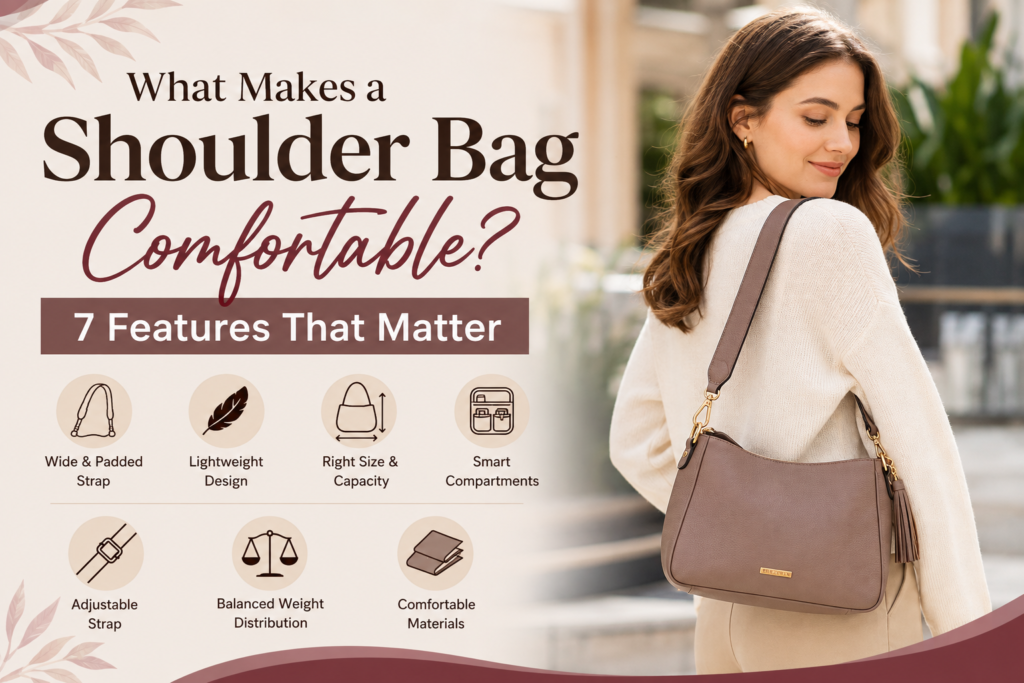
A shoulder bag should do more than complete an outfit. It should feel comfortable during commuting, shopping, workdays, travel, and everyday activities. A stylish bag can quickly become frustrating if the strap digs into your shoulder, the weight feels uneven, or you constantly struggle to find your essentials.
So, what makes a shoulder bag comfortable? The answer comes down to several design features, including strap construction, weight, size, compartments, material, balance, and adjustability.


In this guide, we explore 7 important features that influence shoulder bag comfort and explain what to look for before choosing one.
Why Does Shoulder Bag Comfort Matter?
A shoulder bag often stays against your body for hours. If its design does not distribute weight properly, you may experience discomfort around the shoulder and upper back.
Comfort becomes especially important when you use your bag for:
- Office commuting
- Shopping
- College or university
- Travel
- Daily errands
- Business meetings
- Long walks
- Public transportation
A comfortable shoulder bag should allow you to carry your essentials without constantly adjusting the bag or changing shoulders.
Simple Comfort Analysis
| Feature | Low Comfort | Better Comfort |
|---|---|---|
| Strap | Thin and rigid | Wide and padded |
| Weight | Heavy when empty | Lightweight |
| Size | Too small or oversized | Appropriate for essentials |
| Compartments | One large compartment | Organized sections |
| Material | Stiff and uncomfortable | Flexible and comfortable |
| Balance | Weight concentrated on one side | Evenly distributed |
| Adjustability | Fixed strap | Adjustable strap |
1. A Wide and Comfortable Shoulder Strap
The shoulder strap is one of the most important parts of a shoulder bag.
A narrow strap can concentrate the bag’s weight on a small area of your shoulder. A wider strap spreads the pressure across a larger surface, which can make the bag feel more comfortable during extended use.


What Should You Look For?
Wide strap: Helps distribute pressure more effectively.
Soft or padded construction: Reduces the feeling of a strap digging into the shoulder.
Smooth edges: Rough or sharp strap edges can cause irritation.
Strong attachment points: The strap should connect securely to the bag.
Why Strap Width Matters
Imagine carrying the same 2 kg load with two different straps. A thin strap concentrates the load into a smaller area, while a wider strap distributes it over more of the shoulder.
| Strap Design | Comfort Level | Best For |
|---|---|---|
| Very thin | Low | Lightweight bags |
| Medium width | Moderate | Everyday use |
| Wide | High | Regular or longer use |
| Wide + padded | Very high | Heavier everyday loads |
Practical Tip
If you regularly carry a wallet, phone, cosmetics, notebook, charger, water bottle, and other items, consider a wider and softer strap rather than a very narrow decorative strap.
2. Lightweight Construction
A bag should not feel heavy before you even put anything inside it.
The weight of the bag itself contributes to the total load you carry. A lightweight construction leaves more room for your everyday essentials without making the overall bag unnecessarily heavy.


Think About Total Carry Weight
Your actual carrying weight is:
Bag weight + contents = total load
For example:
| Bag | Empty Weight | Contents | Approx. Total |
|---|---|---|---|
| Bag A | 500 g | 1.0 kg | 1.5 kg |
| Bag B | 800 g | 1.0 kg | 1.8 kg |
| Bag C | 1.2 kg | 1.0 kg | 2.2 kg |
Even before adding your belongings, a heavier bag can increase the total load.
What Makes a Bag Lightweight?
Manufacturers can reduce unnecessary weight through:
- Lightweight fabrics
- Slim hardware
- Minimal decorative elements
- Efficient lining
- Lightweight zippers
- Carefully selected structural materials
Lightweight Doesn’t Mean Flimsy
This is an important distinction.
A comfortable bag should be light without sacrificing durability. Weak stitching, poor-quality hardware, or an unstable structure can make a bag uncomfortable and less practical.
The goal is:
Light enough to carry comfortably, strong enough for everyday use.
3. The Right Size and Capacity
A comfortable shoulder bag should have enough space for your essentials—but not so much space that you are tempted to carry unnecessary items.
An oversized bag can encourage overpacking, increasing the load on your shoulder. A bag that is too small can force you to squeeze or stack your belongings awkwardly.


Choose Size According to Your Routine
| Usage | Suitable Size | Typical Essentials |
|---|---|---|
| Quick errands | Small | Phone, cards, keys |
| Everyday use | Medium | Phone, wallet, cosmetics, charger |
| Office | Medium/Large | Notebook, documents, electronics |
| Travel | Large | Multiple personal essentials |
The “Essential Items” Test
Before purchasing a bag, list the items you normally carry.
For example:
- Smartphone
- Wallet
- Keys
- Sunglasses
- Small cosmetics pouch
- Charger
- Notebook
- Water bottle
Then ask:
Can everything fit comfortably without forcing the bag to bulge?
If yes, the size is probably appropriate.
Avoid Overloading
A large bag isn’t automatically a better bag.
If you consistently fill every available space, the bag can become unnecessarily heavy. Choosing the right capacity encourages better organization and prevents excessive loading.
4. Smart Compartments and Organization
Organization might not seem directly connected to comfort, but it makes a significant difference to everyday usability.
Imagine carrying a bag with one large compartment. Your phone falls underneath your wallet, keys disappear beneath cosmetics, and you have to repeatedly search through the bag.
A well-organized interior solves this problem.


Useful Shoulder Bag Compartments
A practical design may include:
- Main compartment
- Zipper pocket
- Phone pocket
- Card slots
- Small accessory pocket
- Key holder
- Secure external pocket
Why Organization Improves Comfort
Good organization can help you:
- Find items faster.
- Prevent items from moving around excessively.
- Distribute weight more evenly.
- Avoid repeatedly removing everything from the bag.
- Keep frequently used items accessible.
Simple Organization Comparison
| Bag Interior | Organization | Everyday Convenience |
|---|---|---|
| One large compartment | Low | Low |
| Main + small pocket | Moderate | Good |
| Multiple functional compartments | High | Very good |
| Purpose-built compartments | Very high | Excellent |
However, more compartments are not always better. Too many pockets can add weight and make the interior complicated. The best design uses compartments where they are actually useful.
5. Adjustable Strap Length
Everyone has a different body shape, height, and carrying preference. That’s why an adjustable shoulder strap can make a major difference.


An adjustable strap lets you position the bag according to your body and activity.
Why Adjustability Matters
You may want the bag:
- Higher while walking through crowded areas
- Lower for casual styling
- Closer to the body when commuting
- Longer when wearing a thick jacket
- Shorter when carrying fewer items
Fixed vs Adjustable Straps
| Strap Type | Flexibility | Comfort Potential |
|---|---|---|
| Fixed | Low | Limited |
| Slightly adjustable | Moderate | Good |
| Fully adjustable | High | Excellent |
What Makes a Good Adjustable Strap?
Look for:
- Secure adjustment hardware
- Strong stitching
- Smooth adjustment
- Enough length range
- Hardware that doesn’t constantly slip
An adjustable strap also gives you greater flexibility when switching between different outfits and carrying positions.
6. Balanced Weight Distribution
A comfortable bag isn’t only about how much it weighs. Where the weight sits matters too.
If heavy objects are concentrated at one end or far away from your body, the bag can feel awkward even when the total weight is relatively low.


How Does Weight Distribution Work?
Consider two bags with the same total weight.
Bag A: Heavy items are concentrated in one corner.
Bag B: Items are positioned more evenly across the interior.
Bag B will generally feel more stable because the weight is distributed more evenly.
A Simple Weight Distribution Guide
| Design | Weight Distribution | Carrying Experience |
|---|---|---|
| Heavy items at one end | Poor | Unstable |
| Heavy items loosely placed | Moderate | Can shift while walking |
| Structured interior | Good | More stable |
| Balanced compartments | Excellent | More comfortable |
How You Can Improve Balance
Place heavier objects such as:
- Water bottles
- Power banks
- Small electronics
- Notebooks
closer to the center of the bag and nearer your body, while lighter items can occupy outer or smaller compartments.
This can make the bag feel more stable while walking.
7. Comfortable, Flexible and Breathable Materials
The material of a shoulder bag affects more than appearance. It influences weight, flexibility, durability, and how the bag feels against your body.


A very rigid bag may look structured and elegant, but it may not move naturally with your body. A softer construction can provide a more flexible carrying experience.
Common Material Characteristics
| Material Type | Weight | Flexibility | Typical Feel |
|---|---|---|---|
| Soft leather | Medium | High | Premium and flexible |
| Synthetic leather | Low–Medium | Medium–High | Smooth and structured |
| Canvas | Low | High | Casual and flexible |
| Nylon | Very low | High | Lightweight and practical |
| Rigid structured material | Medium–High | Low | Formal and firm |
What Should You Consider?
Look at:
Softness: Does the material feel comfortable against your body?
Flexibility: Can the bag move naturally when you walk?
Breathability: Will the area touching your body become uncomfortable in warm weather?
Durability: Can the material handle regular use?
Maintenance: Is it easy to clean and care for?
The ideal material depends on your lifestyle. A professional may prefer a structured material for office use, while someone who walks frequently may prefer a softer and lighter construction.
The 7 Features at a Glance
Here is a quick comparison of the seven comfort factors:
| Comfort Feature | Why It Matters | What to Look For |
|---|---|---|
| Wide strap | Reduces concentrated pressure | Wide, soft, smooth strap |
| Lightweight construction | Reduces total carrying load | Lightweight but durable materials |
| Right size | Prevents overpacking | Size matched to your routine |
| Smart compartments | Improves organization | Functional pockets |
| Adjustable strap | Fits different body types | Secure length adjustment |
| Balanced design | Improves stability | Even internal weight distribution |
| Comfortable materials | Improves flexibility and feel | Soft, durable, suitable material |
How to Test a Shoulder Bag Before Buying
You don’t always need to rely on appearance or product descriptions. A few simple tests can help you evaluate comfort.
1. The Strap Test
Put the bag on your shoulder.
Ask:
Does the strap feel comfortable, or does it immediately press into one small area?
2. The Weight Test
Put your usual essentials inside.
Don’t test an empty bag if you normally carry several items.
3. The Movement Test
Walk around with the bag.
Check whether:
- It stays in position.
- It swings excessively.
- The strap slips.
- The bag feels unstable.
4. The Access Test
Try taking out your phone, wallet, or keys without removing the bag.
A comfortable bag should also be convenient.
5. The Organization Test
Check whether your essentials have logical places.
If everything falls into one large compartment, everyday use may become frustrating.
Comfortable Shoulder Bag vs Stylish Shoulder Bag: Do You Need to Choose?
Not necessarily.
Modern shoulder bags can combine comfort, functionality, and fashion.
A well-designed bag can have:
- A fashionable silhouette
- Elegant hardware
- A comfortable strap
- Lightweight construction
- Useful compartments
- Adjustable carrying options
- Enough space for everyday essentials
The key is to evaluate the design as a whole, rather than choosing a bag only because it looks attractive.
How to Choose a Comfortable Shoulder Bag for Different Lifestyles
Your ideal bag depends heavily on how you use it.
| Lifestyle | Most Important Features |
|---|---|
| Office professional | Organization, structure, adjustable strap |
| College student | Lightweight design, capacity, durable material |
| Frequent traveler | Secure compartments, adjustable strap, lightweight construction |
| Daily commuter | Wide strap, balanced weight, organization |
| Minimalist | Compact size, lightweight construction |
| Shopper | Comfortable strap, flexible material, adequate capacity |
| Occasional user | Lightweight construction, style, practical storage |
Common Shoulder Bag Comfort Mistakes
Even a well-designed bag can become uncomfortable if it is used incorrectly.
Overpacking
Carrying items you don’t need increases the total load.
Choosing Style Over Function
A very narrow strap or heavy decorative hardware may look attractive but reduce everyday comfort.
Ignoring Strap Length
A strap that is too short or too long can affect how the bag sits on your body.
Using the Wrong Size
A bag that is too small can become overcrowded, while a large bag can encourage unnecessary carrying.
Carrying Heavy Items on One Side
Poor organization can cause weight to collect in one area.
A Simple Shoulder Bag Comfort Scorecard
You can use this quick checklist when comparing different bags.
| Feature | Score 1–5 |
|---|---|
| Strap comfort | ⭐⭐⭐⭐⭐ |
| Bag weight | ⭐⭐⭐⭐⭐ |
| Size and capacity | ⭐⭐⭐⭐⭐ |
| Interior organization | ⭐⭐⭐⭐⭐ |
| Strap adjustability | ⭐⭐⭐⭐⭐ |
| Weight balance | ⭐⭐⭐⭐⭐ |
| Material comfort | ⭐⭐⭐⭐⭐ |
| Total | /35 |
How to Interpret the Score
- 30–35: Excellent everyday comfort potential
- 25–29: Very good
- 20–24: Moderate
- Below 20: Consider other options
This isn’t a scientific medical measurement. It is simply a practical way to compare bags using the same criteria.
Conclusion
A comfortable shoulder bag is the result of multiple design choices working together.
The seven features that matter most are:
- A wide and comfortable strap
- Lightweight construction
- The right size and capacity
- Smart compartments
- An adjustable strap
- Balanced weight distribution
- Comfortable and flexible materials
The best shoulder bag isn’t necessarily the largest, most expensive, or most fashionable option. It is the one that fits your body, routine, belongings, and carrying habits.
Before buying, think beyond the appearance. Put your everyday essentials inside, check the strap, test the weight, examine the compartments, and see how the bag behaves when you move.
When comfort and design work together, a shoulder bag becomes more than an accessory—it becomes an effortless part of your everyday routine.