

Introduction
Your everyday bag needs to do more than complete an outfit. It should make it easy to carry the things you need, find them quickly, and move comfortably throughout the day.
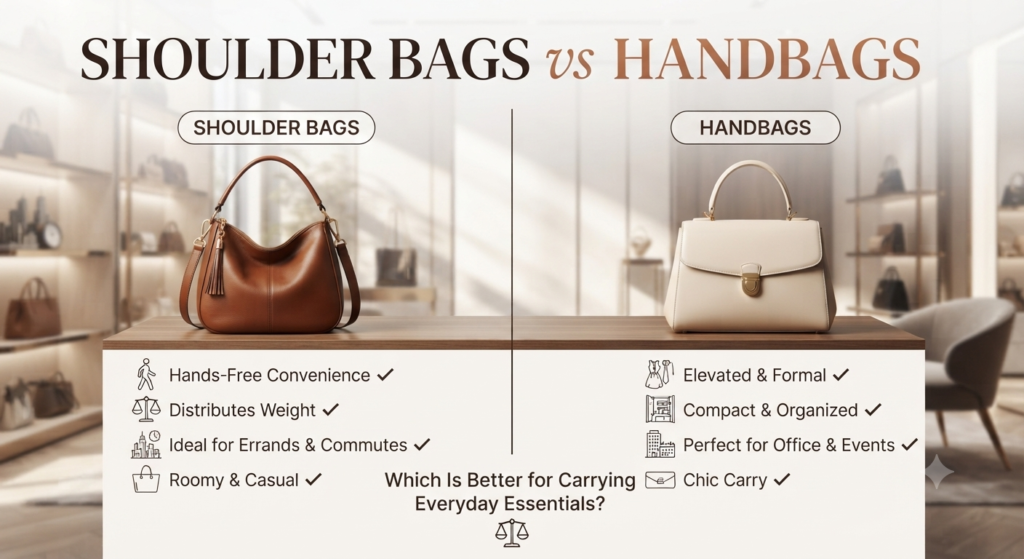
Shoulder bags and handbags are two popular choices, but they offer different carrying experiences. A shoulder bag is designed primarily to rest on the shoulder, while a traditional handbag is generally carried by its shorter handles or held in the hand or on the forearm.
So, which one is better for carrying everyday essentials?
For most people who want hands-free convenience, easy access, and practical everyday carrying, a shoulder bag can be the more functional choice. A handbag may be preferable when structure, polished appearance, and hand-carrying are more important.
What Counts as an Everyday Essential?
Before comparing the bags, think about what you actually carry every day.
Typical everyday essentials include:
- Smartphone
- Wallet or cardholder
- House and car keys
- Sunglasses
- Lip balm or lipstick
- Hand sanitizer
- Tissues
- Small makeup items
- Earphones
- Portable charger
- Small notebook and pen
- Water bottle, depending on bag size
The ideal bag should accommodate these items without becoming unnecessarily heavy or difficult to organize.


Shoulder Bags vs Handbags: Quick Comparison
| Feature | Shoulder Bag | Traditional Handbag |
|---|---|---|
| Primary carrying method | Over the shoulder | Hand or forearm |
| Hands-free convenience | Excellent | Limited |
| Quick access | Very good | Good |
| Everyday mobility | Excellent | Moderate |
| Organization | Often good | Depends on design |
| Weight management | Convenient for moderate loads | Can feel tiring when hand-carried |
| Security | Good with zip/flap closures | Depends on closure and how it is carried |
| Office suitability | Excellent | Excellent |
| Casual use | Excellent | Very good |
| Best for | Everyday essentials and mobility | Polished looks and structured carrying |
Note: This comparison refers to a traditional hand-carried handbag. The handbag category is broad and can include styles with shoulder or crossbody straps, so individual designs may perform differently.
1. Carrying Comfort
Comfort becomes especially important when you carry a bag for several hours.
A shoulder bag allows the bag to hang from your shoulder rather than requiring you to continuously grip a handle. This can make it more convenient when walking, shopping, commuting, or moving between different activities.
A handbag with short handles requires more active hand or forearm support. It can still be comfortable when the load is light, but a heavier bag may become inconvenient over time.
Winner: Shoulder Bag
For everyday mobility, the shoulder bag has a practical advantage.
Tip: Avoid overloading a shoulder bag. Even a comfortable strap can become uncomfortable when the bag becomes unnecessarily heavy.
2. Hands-Free Convenience
This is one of the biggest functional differences.
With a shoulder bag, your hands remain available for:
- Using your phone
- Carrying shopping bags
- Opening doors
- Holding a coffee
- Using public transport
- Taking care of children
- Walking or commuting
A traditional handbag usually needs to be carried by hand or supported on the arm.
Winner: Shoulder Bag
If you are constantly moving throughout the day, hands-free carrying can make a significant difference.


3. Accessibility: Which Bag Lets You Reach Your Essentials Faster?
Imagine you are standing at a checkout counter and need your wallet.
A well-designed shoulder bag can remain on your shoulder while you open the zipper or flap and retrieve what you need. This makes frequent access convenient.
A traditional handbag may need to be held, placed on a surface, or supported with your other hand while you search through it.
Winner: Shoulder Bag
However, organization matters. A shoulder bag with multiple compartments or pockets can make frequently used items much easier to find.
4. Storage and Organization
Storage isn’t simply about having a large interior. Good organization helps you use the available space efficiently.
Look for:
- Main compartment
- Zipper pocket
- Phone pocket
- Cardholder slot
- Key attachment
- Small accessory pockets
Shoulder bags often prioritize practical organization in a relatively compact design. Traditional handbags can offer excellent storage too, especially structured models with multiple compartments.
Winner: Tie
The design of the individual bag matters more than the category.


5. How Much Can You Carry?
This depends heavily on size.
A small shoulder bag may comfortably carry:
Phone + wallet + keys + sunglasses + lipstick + earphones
A medium or large shoulder bag may accommodate additional items such as:
Notebook + charger + cosmetics pouch + small water bottle
A structured handbag can also offer generous capacity, but its shape and handle design may make heavier loads less convenient to carry by hand.
Best choice depends on your load
Light-to-moderate everyday essentials → Shoulder bag
Larger loads with structured storage → Larger handbag or tote-style design
The important thing is to choose capacity based on what you actually carry rather than buying the largest bag available.
6. Security and Protection
Your everyday bag carries valuable and important belongings, so security matters.
A shoulder bag with a zipper, magnetic closure, or flap can help keep your belongings contained. Because the bag remains close to your body, it can also be easier to keep track of while moving through busy places.
Traditional handbags can also be secure when properly closed and carried carefully.
Winner: Slight advantage to shoulder bags
The closure design is ultimately more important than the bag category.
7. Which Is Better for Work?
For office use, both styles can work well.
Choose a shoulder bag if you carry:
- Phone
- Wallet
- Keys
- Small notebook
- Charger
- Cosmetics
- Personal essentials
Choose a larger structured handbag or tote if you need:
- Laptop
- Documents
- Large notebook
- Water bottle
- Lunch
- Multiple work accessories
A recent comparison of everyday bag styles similarly emphasizes that the right choice depends on how much you carry and whether your priority is capacity or a lighter, more organized everyday load.
8. Which Is Better for Shopping and Errands?
Shoulder bags are particularly useful for errands because they keep your hands available.
Imagine doing several small tasks:
Coffee → Grocery store → ATM → Phone call → Shopping
A shoulder bag can stay on your body while your hands remain available for other activities.
A traditional handbag may need to be held or placed down repeatedly.
Winner: Shoulder Bag
For busy days involving a lot of movement, functionality often matters more than formal appearance.
9. Which Is Better for Travel?
For travel, the choice depends on your itinerary.
A shoulder bag can be useful for carrying:
- Passport
- Phone
- Wallet
- Tickets
- Sunglasses
- Travel documents
- Small charger
For larger travel loads, however, you may need a separate tote, backpack, or luggage.
Winner for travel essentials: Shoulder Bag
Winner for large travel loads: Larger tote or travel bag
Functional Scorecard
The following is an illustrative editorial score, not a consumer survey. It compares the two styles specifically for everyday essentials on a 1–5 scale.
The chart highlights an important point: there isn’t one universally better bag. Shoulder bags generally prioritize mobility and convenience, while traditional handbags can excel when a structured, polished appearance is the priority.
Shoulder Bag vs Handbag: Which Should You Choose?
Choose a Shoulder Bag If You:
- Carry essentials throughout the day
- Prefer hands-free convenience
- Walk or commute frequently
- Want quick access to your belongings
- Prefer organized compartments
- Need a practical everyday bag
- Want a bag that works for casual and office settings
Choose a Handbag If You:
- Prefer carrying a bag by hand or forearm
- Want a more structured appearance
- Prioritize formal styling
- Carry a moderate load
- Frequently attend meetings or occasions where a polished look matters
How to Choose the Right Everyday Bag
Instead of choosing based only on appearance, ask yourself five questions:
1. What do I carry every day?
Make a list of your essentials.
2. How long do I carry my bag?
If you carry it for several hours, comfort should be a priority.
3. Do I need my hands free?
If you’re frequently walking, commuting, shopping, or multitasking, a shoulder bag can be especially convenient.
4. Do I need organization?
Look for dedicated pockets for small essentials.
5. Do I need a large capacity?
If you regularly carry a laptop, documents, or larger items, look beyond a compact everyday shoulder bag.
The Smartest Approach: Choose Based on Your Routine
You don’t necessarily have to choose just one.
A shoulder bag can become your everyday option for errands, commuting, shopping, and casual outings.
A structured handbag can be reserved for meetings, formal occasions, dinners, and situations where you want a more polished appearance.
Having both gives you flexibility without forcing one bag to handle every situation.


Conclusion
When the main goal is carrying everyday essentials comfortably and conveniently, a shoulder bag is often the more functional choice.
Its shoulder strap provides hands-free convenience, while a well-organized interior makes it easier to carry and access your daily necessities. Traditional handbags remain excellent choices when you prioritize a structured silhouette and polished appearance.
The best everyday bag isn’t necessarily the biggest or most fashionable one. It’s the one that fits your essentials, matches your routine, and remains comfortable throughout your day.
Quick takeaway
| Your Priority | Better Choice |
|---|---|
| Hands-free convenience | Shoulder Bag |
| Everyday mobility | Shoulder Bag |
| Quick access | Shoulder Bag |
| Organized essentials | Shoulder Bag / Depends on design |
| Formal appearance | Handbag |
| Hand-carrying | Handbag |
| Light everyday load | Shoulder Bag |
| Larger work load | Larger handbag/tote |
Everyday Functionality Scorecard
Illustrative 1–5 editorial assessment of traditional shoulder bags versus hand-carried handbags for everyday essentials.
| feature | shoulderBag | handbag |
|---|---|---|
| Hands-free use | 5 | 2 |
| Accessibility | 5 | 3 |
| Organization | 4 | 4 |
| Mobility | 5 | 3 |
| Moderate load | 4 | 3 |
| Formal appearance | 4 | 5 |